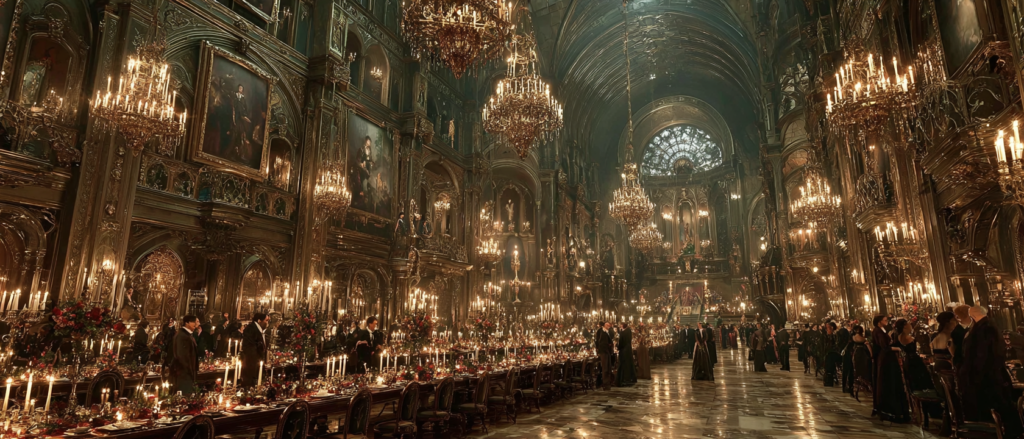
ⓒ 2026 Rich & Rich A grand and majestic scene in a magnificent banquet hall filled with chandeliers and portraits, where numerous family members are gathered.
1. Build a Fortress: The Victory of Trusts and Systems
The first secret to the Rockefellers’ enduring wealth lies in a rigorous system that does not rely on individual morality alone. John D. Rockefeller Sr. designed a powerful trust structure to prevent assets from being scattered by individual greed or poor management.
The family trusts established in 1934 and 1952 continue to serve as the backbone of their wealth. These are designed as irrevocable trusts, protecting assets from external legal disputes or creditors while restricting heirs from withdrawing the principal at will. By vesting ownership in the trust and distributing only the generated income to heirs, they have effectively prevented the mistake of killing the goose that lays the golden eggs.
Furthermore, through Rockefeller Capital Management, their family office, a group of professionals manages the assets. This minimizes the risk of family members without specialized knowledge managing the portfolio.
2. The Waterfall Method: A Never-Ending Cycle of Capital
The Rockefellers utilize a waterfall strategy where assets do not decrease over time but rather grow as they pass through generations. The core of this strategy is a sophisticated combination of life insurance and trusts.
When a family heir is born, the trust takes out a large life insurance policy on that child. The premiums are paid by the trust, and decades later, when that individual passes away, a massive death benefit flows back into the trust. These funds are then used for new insurance policies and investment capital for the next generation. This structure allows capital to circulate infinitely with minimized tax exposure, leading to the phenomenon where the family’s total wealth actually grows as the number of heirs increases.
3. Family Governance: Uniting Over 200 Heirs
The greatest enemy of a large family is not external competition, but internal discord. To prevent this, the Rockefellers operate a powerful governance system known as the Family Forum.
More than 270 family members gather twice a year at historic family estates or in New York City. These meetings, such as the annual Christmas luncheon, allow relatives to share the family’s history and values. This forum goes beyond social gatherings; it serves as a platform to reaffirm the family vision, share asset management status, and resolve potential conflicts through dialogue.
A key element is the induction ceremony for heirs who reach the age of 21, which instills a sense of pride and immense responsibility in the younger generation as official members of the family.
4. The Capitalist Mindset: Touching the Principal is a Sin
One of the most strictly taught principles in the Rockefeller family is to never touch the capital or principal. Heirs are taught that they must live only on the dividend income from the trust or their own earned income, while the principal that forms the root of the family must be preserved solely for investment and growth.
John D. Rockefeller Sr. taught his children from a young age to keep a ledger, recording every cent of income and expenditure. The four pillars of “Invest, Save, Spend, Give” remain a family motto passed down to the seventh generation. This educational system, which views wealth as a tool and responsibility for improving the world rather than a means for consumption, is the spiritual pillar of the family’s longevity.
5. Philanthropy: A Common Goal to Unite the Family
For the Rockefellers, philanthropy is not just a tax deduction tool. Charitable activities serve as a powerful adhesive that unites family members under a common mission.
John D. Rockefeller believed that the talent for making money was a gift from God, and using that wealth for society was a duty. Through the Rockefeller Foundation and the Rockefeller Brothers Fund, heirs learn to work together to solve various social challenges such as education, healthcare, and environmental protection. The process of heirs serving on these boards and making decisions serves as a practical training ground for leadership and asset management.
Conclusion: Wealth Permanence Can Be Designed
The Rockefeller case clearly demonstrates that wealth is not maintained by luck or talent alone. It is the result of a comprehensive system combining legal instruments (trusts), sustainable capital cycles (insurance), democratic family communication (governance), and rigorous economic education.
If you dream of a 100-year legacy, you must consider how to project these five rules into your own asset system. Anyone can pass down money, but only a prepared capitalist can pass down the values and systems that sustain that wealth.