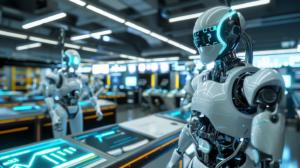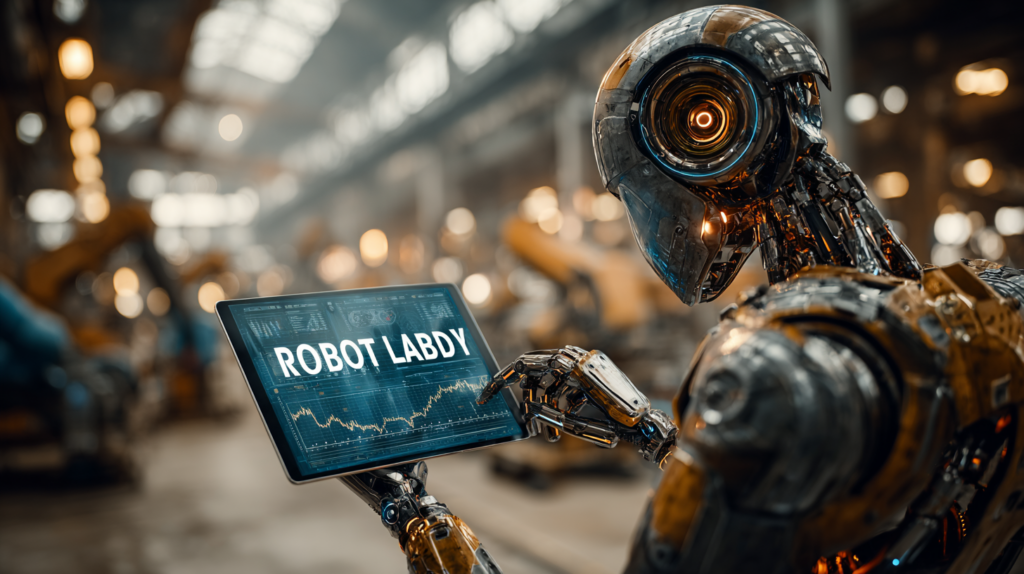
ⓒ 2026 Rich & Rich An advanced humanoid robot analyzing "Robot Labor" metrics and financial charts on a digital tablet.
1. The Grand Rift in Human History: From Human Labor to Robot Labor
From the agrarian age through the Industrial Revolution to the current information age, the single greatest variable in business management has always been human labor. Under the capitalist system, labor is an essential element of production, but for the entrepreneur, it has consistently been an increasing variable cost and a complex operational risk. Rising wages, benefit costs, labor disputes, and the fatigue and errors inherent in being human have acted as an invisible ceiling on corporate operating margins.
However, we are now standing at a major turning point in human history: shifting from the era of renting human labor to the era of owning robot labor. The combination of humanoid robots and artificial intelligence is transforming labor into an infinitely replicable asset with a marginal cost that nears zero once depreciation is complete. This shift marks the beginning of the end for labor as a variable expense.
2. Robot Labor: The Disruptive Reconstruction of Balance Sheets
As robots like Tesla’s Optimus or Figure AI units enter the actual industrial field, corporate balance sheets will be reconstructed in ways that defy traditional common sense. This is not merely an efficiency improvement; it is a fundamental collapse and rebuilding of business models.
- The Revolution of Utilization: The 24/7/365 System
- Human workers require rest, sleep, and weekends, with actual focused work time often limited to 6 or 7 hours a day.
- In contrast, robot labor can operate at full capacity 24 hours a day, excluding charging time.
- This means that the production output from the same facility assets can triple by simple calculation.
- Monthly labor costs that vanish upon payment are being converted into fixed assets in the form of robot labor.
- Once mass production of robots is established and the price per unit drops significantly, a staggering ROI occurs where the investment can be recovered within a single year.
- As the efficiency of machines fills the gap left by the removal of human labor costs, manufacturing operating margins could leap to 40 or 50 percent or more.
3. Comparative Analysis: Human Labor vs. Robot Labor
| Item | Human Labor (Current) | Robot Labor (Future) |
| Cost Nature | Monthly variable cost (OPEX) | Fixed asset recovered after input (CAPEX) |
| Energy Efficiency | Requires food, rest, and housing | Electric charging and precision management |
| Replicability | Takes years for education and skill | Immediate skill sharing via data upload |
| Scalability | Management costs increase with hiring | Immediate replication for line expansion |
| Risk | Strikes, injuries, and turnover risks | Resolved via maintenance and parts |
4. The Equity of Robot Labor: Owning Labor by Owning Machines
The core insight for young capitalists in this change is the assetization of robot labor. In the past, becoming wealthy required being a boss with thousands of employees. In the future, the measure of wealth will be who holds more shares in robot labor.
Investing in innovative companies like Tesla or Figure AI is not simply about buying stock in a company that makes machines. It is about securing equity in the total future robot labor pool to be created globally. The shares you own become permanent rights to the cash flow generated by tens of millions of robots that never sleep. This is why we say: do not perform labor yourself; own robot labor.
5. The Connection to Energy Hegemony: Robots Eat Electricity
For legions of robot labor to move, a massive amount of cheap and stable power is essential. Here, we reaffirm the importance of the energy hegemony discussed in previous analyses.
- Small Modular Reactors (SMRs) serve as the heart, providing uninterrupted energy to robot labor forces right next to factories or data centers.
- Copper will become the veins connecting the complex neural networks of robots and power grids, leading to a demand explosion.
- When production tools like AI and humanoids are combined on top of the energy foundation of SMRs and copper, the true era of zero marginal cost is completed.
- Only investors who understand this massive puzzle will emerge victorious in the coming reshuffling of wealth.
6. Paying the Toll of Volatility
Disruptive innovation never happens linearly. Stock prices will show extreme volatility as they collide with technical flaws, ethical debates, government regulations, and market pessimism. However, history has always been on the side of technology that replaces inefficiency with efficiency.
Rather than agonizing over current yield charts, imagine what the production sites of humanity will look like in ten years. At the point where human muscle labor is completely replaced by robot labor, a technological singularity will occur, and the resulting cash flow will exceed current imaginations.
7. Strategic Advice for a 100-Year Legacy: Own the Roads and the Engines
Rich & Rich provides clear guidelines for our readers. Own the roads by preempting the physical foundation of the AI revolution through SMRs and the copper supply chain. Own the engines by accumulating shares in companies leading humanoid technology to turn future robot labor into your personal assets.
If energy hegemony paves the road, robotics is the engine of wealth running on that road. Grasping these two axes simultaneously is the most certain master plan for building an unshakable empire of wealth. The technical stability of our platform, evidenced by our CLS 0 rating, ensures that these insights are delivered reliably to support your decision-making.