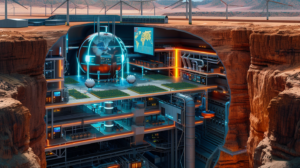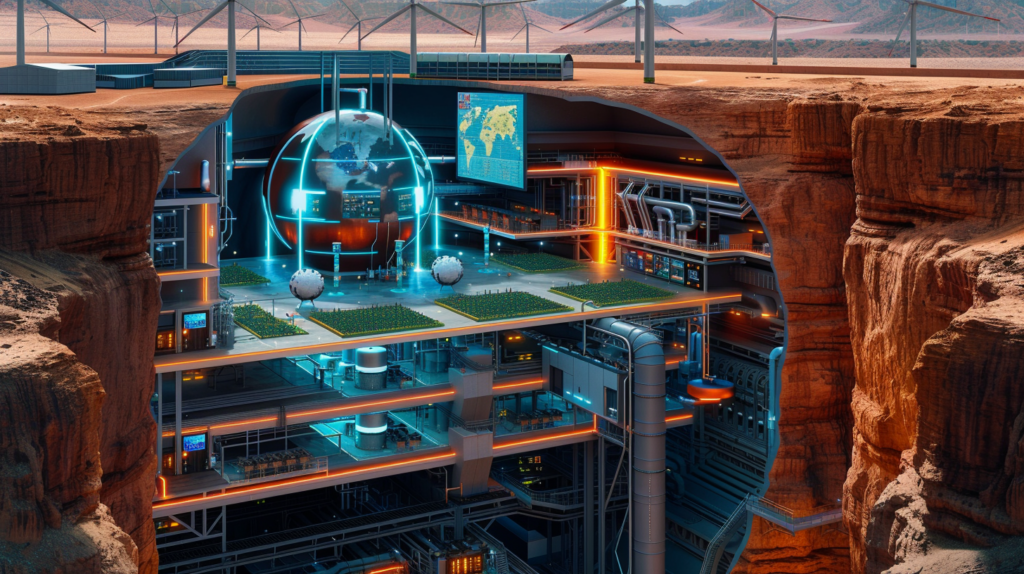
ⓒ 2026 Rich & Rich A detailed cutaway illustration of a futuristic underground energy hub and city built into a desert canyon.
In the spring of 2026, the world stands at a civilizational crossroads. The escalating tensions between the United States and Iran have moved beyond mere regional skirmishes, signaling the definitive end of the post-Cold War era of globalization. For decades, the global economy operated under the “Just-in-Time” philosophy—a world where parts were sourced where they were cheapest and shipped through open seas without a second thought.
Today, that world is dying. In its place, a new, grimmer, yet technologically vibrant era is emerging: Security Capitalism. In this new paradigm, the primary metric of industrial success is no longer “efficiency” or “profit margins,” but “resilience” and “sovereignty.” As the drums of war beat in the Middle East, industries are being forced to retreat into technological and geographical fortresses.
I. The Energy Rupture: From Commodity to Hostage
The Chokehold of Hormuz
The Strait of Hormuz, through which 20% of the world’s petroleum flows, has long been the jugular vein of the global economy. In a full-scale conflict, this vein is not just restricted; it is severed. While the immediate reaction is a spike in crude prices toward the $150–$200 range, the long-term industrial impact is far more profound. Oil has ceased to be a “commodity” traded on market fundamentals; it has become a “strategic hostage.”
For the American industrialist, this means the “Energy Risk Premium” is no longer a temporary line item on a balance sheet. It is a permanent tax on globalization. This realization is triggering a frantic, well-funded retreat from fossil fuel dependency, not just for the sake of the environment, but for the sake of national survival.
The Rise of the SMR: Decentralized Power Fortresses
Centralized power grids and massive coal plants are the low-hanging fruit of modern warfare. A single cyberattack or a well-placed drone can darken a coast. To counter this, the U.S. is accelerating the deployment of Small Modular Reactors (SMRs).
These factory-built, plug-and-play nuclear units represent the ultimate “Energy Vault.” They allow a high-tech manufacturing cluster or a massive AI data center to operate entirely off-grid, independent of the geopolitical volatility of the Middle East. SMRs are the cornerstone of the new industrial fortress, providing a “sovereign sun” that keeps the lights on even when the Strait of Hormuz is in flames.
II. The Digital Trenches: AI and the New Military-Industrial Complex
The U.S.-Iran conflict marks the world’s first “Algorithm War.” This is not a conflict won by the side with the most steel, but by the side with the most sophisticated software.
Autonomous Swarms: The Death of Traditional Armor
The traditional image of war—massive aircraft carriers and columns of tanks—is being rendered obsolete by drone swarms. Iran’s sophisticated drone tactics, met by American AI-driven interception systems, have turned the battlefield into a high-speed computational race.
Industrially, this means the “Defense” sector is merging with “Big Tech.” The most valuable military assets are no longer the hulls of ships but the AI agents that can make split-second decisions in the chaos of a swarm attack. This shift is fueling a massive boom in the “Edge Computing” industry, as processing power must now be located at the very tip of every drone and missile.
Cybersecurity as the New Infrastructure
When a state actor like Iran targets the American financial or electrical grid, cybersecurity stops being an “IT expense” and becomes “Critical Infrastructure.” The future industry of Digital Walls—incorporating AI-driven threat detection and quantum-resistant encryption—is becoming as essential as the highway system was in the 1950s.
III. The End of the Global Village: Friend-Shoring and Vertical Integration
For thirty years, CEOs were rewarded for “Outsourcing.” Today, they are being rewarded for “In-sourcing.” The war has exposed the lethal flaw in long, fragile supply chains.
The Return of Vertical Integration
We are seeing the return of the “Industrial Giant” of the early 20th century, where a single company owns everything from the mine to the finished product. To avoid being held hostage by mineral-rich nations or blocked shipping lanes, companies are aggressively pursuing “Urban Mining”—the recycling of e-waste to recover lithium, cobalt, and rare earth elements. Recycling is no longer a green initiative; it is a resource security imperative.
The “Friend-Shoring” Blockade
The world is splitting into closed economic blocks. Trade is now restricted to a “Circle of Trust”—nations that share the same security interests. For the U.S., this means a massive re-industrialization of the “Rust Belt” and a deepening of ties with neighbors like Mexico and Canada. The “Global Village” is being replaced by a series of “Gated Communities.”
IV. Space: The High Ground of Economic Security
With terrestrial cables vulnerable to sabotage and GPS jamming becoming a standard war tactic, the “High Ground” has moved to Low Earth Orbit (LEO).
The Satellite Lifeblood
Networks like Starlink have proven that a nation’s connectivity cannot be cut if its routers are in the sky. In a time of war, LEO satellite constellations become the only reliable backbone for global finance and military command. The space industry is transitioning from “exploration” to “essential utility.” Every major corporation will soon require a “Space Continuity Plan” to ensure their data flows even if the ground-based internet is dark.
V. Macroeconomic Reality: The Permanent Inflation of Security
The American consumer must face a hard truth: Security is expensive.
The Structural Shift in Costs
The era of “cheap stuff” made in distant factories is over. Re-shoring production to the U.S., investing in nuclear energy, and building AI defenses all carry a high price tag. This conflict is cementing a period of structural inflation. The Federal Reserve no longer fights just “market cycles”; it is fighting the “cost of security.”
The Flight to Hard Assets
In a world of fluctuating currencies and digital warfare, capital is flowing back to things that can be touched: Gold, critical mineral mines, and energy infrastructure. These “Hard Assets” are the only stores of value that remain stable when the geopolitical order is in flux.
VI. Conclusion: The New Social Contract of Industry
The U.S.-Iran conflict is the final wake-up call. It tells us that “peace” was a luxury we had grown too accustomed to, and “globalization” was a fair-weather friend.
The industries of the future will be defined by their ability to provide Security. Whether it is an SMR providing energy security, a cybersecurity firm providing digital security, or a localized factory providing supply chain security—these are the new pillars of the 21st-century economy.
We are entering the Age of Fortresses. It will be a more expensive world, a more fragmented world, but perhaps a more resilient one. The companies and nations that recognize this shift and build their technological walls now will be the ones that survive the fire of the coming years.