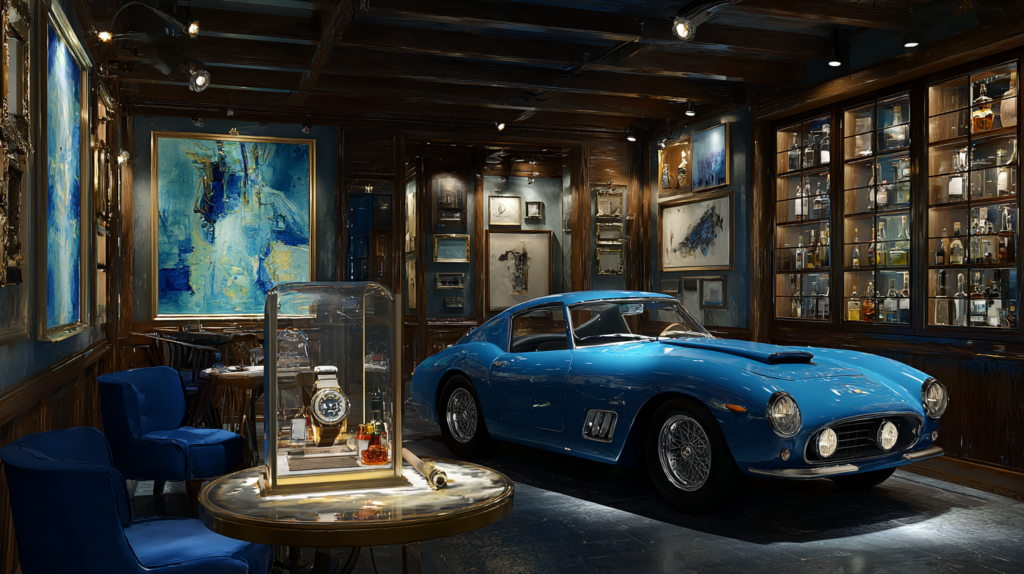
ⓒ 2026 Rich & Rich An image showcasing a collection of alternative investment assets, including a classic car, artwork, timepieces, and rare spirits.
In an era of global currency devaluation and unprecedented economic volatility, the world’s most sophisticated investors are looking beyond traditional financial instruments. They are no longer satisfied with assets that merely track inflation; they seek “Rare Assets”—items whose value does not just persist but amplifies exponentially as time passes. For these individuals, a rare asset is more than a luxury; it is a sophisticated hedge, a cultural statement, and a vessel for transferring family values across generations. Rich & Rich dives into the mechanics of this elite investment class.
1. Blue-Chip Art: The Only Asset with Zero Correlation to Paper Money
Art has long been the cornerstone of alternative investment portfolios for the world’s most prominent families. A masterpiece by a blue-chip artist is not just a painting; it functions as a global, portable, and highly private form of currency.
A Sovereign Store of Value: When stock markets fluctuate or geopolitical tensions rise, the value of a Picasso, a Basquiat, or a Warhol remains remarkably independent. This is due to the absolute scarcity of the asset. There is only one original “Les Femmes d’Alger,” and that exclusivity creates a monopoly for the owner. Elite investors do not just buy art for aesthetic pleasure; they buy it to exit the volatility of fiat currency and enter a market where supply is permanently capped by history.
The Strategy of Generational Transmission: Art possesses the highest value-to-volume ratio of any asset class. For centuries, European and American dynasties have used private museums and charitable foundations to manage their collections. This is not merely philanthropy; it is a sophisticated strategy to maintain the integrity of a family’s wealth, preventing the fragmentation of assets while enhancing the family’s global prestige.
2. High-End Horology: A Mechanical Vault on the Wrist
The market for high-end timepieces has consistently outperformed traditional benchmarks like the S&P 500 over the past decade. For the modern patriarch, a watch from Patek Philippe, Audemars Piguet, or Rolex is not just a tool for telling time; it is a “time-tested” investment.
The Perfection of Scarcity: The reason a Patek Philippe Nautilus or a vintage Daytona commands such a premium is the manufacturer’s deliberate control over supply. Even as global demand skyrockets, the physical limit of how many watches a master watchmaker can produce ensures that these items remain perpetually undersupplied. As we discussed in the context of 100-year buildings, the “perpetuity” of the asset is key. A grand complication watch that is meticulously maintained only becomes more valuable as its parts become rarer and its story grows longer.
Provenance as a Value Multiplier: In the world of rare watches, who owned the piece is often as important as the piece itself. A watch with a documented history—whether it belonged to a historical figure or was part of a legendary collection—carries a “provenance premium” that defies standard depreciation. Sophisticated investors treat their horological collections like a private equity fund, carefully selecting pieces that represent the zenith of engineering and historical significance.
3. Classic Cars and Rare Spirits: The Consumable Assets of the Elite
Investment has moved beyond static objects to “experiential assets” where the pleasure of ownership is matched by the growth in capital value.
Classic Cars as Rolling Sculptures: For the connoisseur, a limited-edition Ferrari or a vintage Porsche from the 1950s is a masterpiece of engineering that happens to be street-legal. Unlike modern supercars that depreciate the moment they leave the showroom, classic cars are treated as historical artifacts. Their value lies in their “originality.” A car that retains its original engine, chassis, and paint—much like a building that retains its original facade—is a blue-chip asset that global collectors compete for at prestigious auctions like Pebble Beach.
The Mathematics of Rare Whisky: Fine wine and rare whisky represent a unique market where consumption actually drives investment returns. The supply of a 50-year-old Macallan is fixed. Every time a bottle is opened and consumed, the remaining bottles become statistically rarer. This automatic scarcity mechanism makes rare spirits one of the most resilient asset classes during inflationary periods. For the investor, a well-curated cellar is a “liquid asset” in every sense of the word.
4. The Mastery of Rare Asset Management: Vision and Preservation
Investing in rare assets requires a completely different mindset than trading stocks or bonds. Success in this field is built on three pillars:
The Science of Provenance: The greatest risk in the rare asset market is the counterfeit. A “bargain” in this world is almost always a trap. The value of a rare asset is 50 percent the object and 50 percent the documentation. Rich & Rich investors must ensure that every acquisition is backed by a flawless “chain of custody” and authenticated by the world’s leading experts. Digital record-keeping and blockchain-based authentication are now becoming the standard for preserving this critical information.
The Philosophy of Preventative Maintenance: Just as a 100-year building requires a proactive maintenance schedule to prevent the erosion of value, so too does a rare asset. Storing art in a climate-controlled vault, keeping a classic car in a humidity-regulated garage, and ensuring a watch undergoes a factory service are not expenses—they are capital protections. An unmaintained rare asset is merely a second-hand item; a perfectly preserved one is a legacy.
The Long-Term Horizon: Rare assets are inherently illiquid. They are not meant for the “day trader” of the wealth world. The true gains are realized by those who have the patience to hold an asset for a decade or even a generation. During this period, the owner gains “emotional dividends” from the beauty and history of the object, which is a return on investment that no spreadsheet can quantify.
🎁 Bonus: Practical Q&A for the Global Sophisticated Investor
Q1. What is the best “entry-level” rare asset for a new investor? A. We recommend starting with high-end horology or limited-edition prints from established contemporary artists. These are more liquid than classic cars and easier to store than large-scale sculptures. However, the rule of “quality over quantity” always applies. It is better to own one exceptional piece with perfect provenance than ten mediocre items.
Q2. How do rare assets fit into a tax-efficient succession plan? A. Rare assets are often excellent vehicles for wealth transfer because their valuation can be managed through expert appraisal and private treaty sales. Many jurisdictions offer tax incentives for donating art to public institutions, which can be used to offset other capital gains. Furthermore, holding these assets within a family trust or an LLC—much like the “incorporation strategy” for real estate—ensures that the collection remains intact even as the family grows.
Q3. What is the most important factor when choosing a dealer or auction house? A. Reputation and historical data. You are paying for their “guarantee” of authenticity. Stick to the “Big Two” auction houses or galleries with a multi-generational history. In the world of rare assets, you are not just buying an object; you are buying the peace of mind that comes with a globally recognized certificate of authenticity.