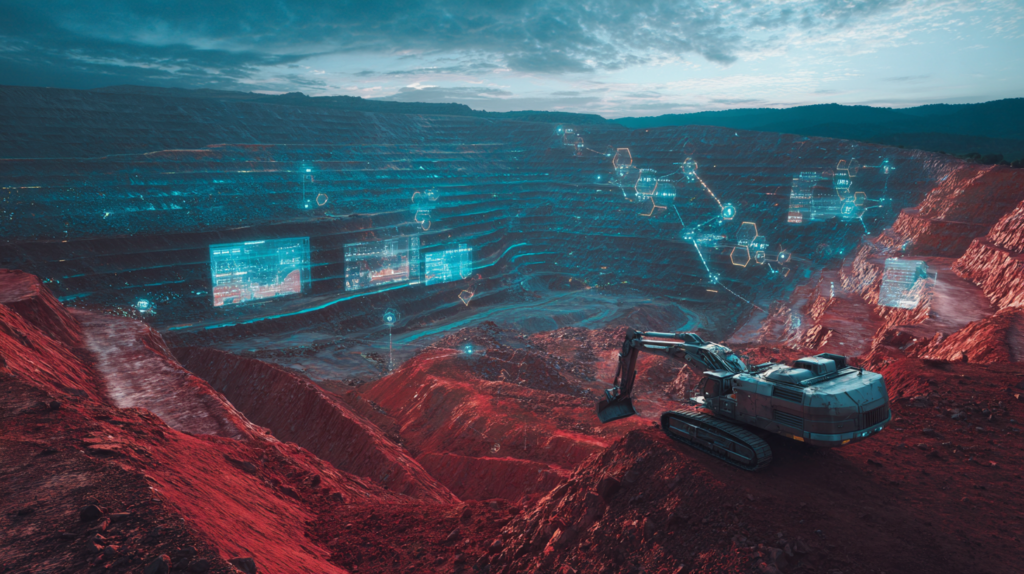
ⓒ 2026 Rich & Rich Panoramic view of a massive futuristic open-pit mine integrated with holographic screens and data networks.
The history of human civilization is written in the materials we master. We have progressed from Stone to Bronze, and from Iron to Silicon. Today, as Artificial Intelligence (AI) and robotics blur the lines between the virtual and physical worlds, we are entering the era of Digital Alchemy. In this new epoch, wealth is not found in gold or silver, but in Rare Earth Elements (REEs) and strategic critical minerals.
For the modern capitalist, the shift is clear: while software dictates the logic of the future, minerals dictate its existence. This report identifies the titans of the supply chain and outlines a 100-year strategy for securing your legacy in the orbital and terrestrial economies.
1. The Raw Materials of Intelligence and Power
To understand the investment thesis, one must first understand why these elements are irreplaceable in the digital infrastructure.
The Muscle: Neodymium (Nd) and Permanent Magnets
AI requires a physical interface—robotics. Neodymium is the essential component of high-strength permanent magnets that allow robots to move with precision. These magnets are also vital for EV motors, AI data center cooling systems, and advanced defense arrays. Rare earths are the literal bridge where digital intelligence is converted into physical kinetic force.
The Blood: Lithium (Li) and Cobalt (Co)
Energy hegemony is no longer just about production; it is about storage. Lithium and Cobalt are the core of the 21st century’s “white oil”. As the world shifts toward Energy Storage Systems (ESS) and electric mobility, these minerals become the fundamental currency of power.
2. The Titans of the Supply Chain: A Targeted List
A strategic portfolio must focus on companies that possess a “geopolitical moat”—those that control either the source or the refining process.
| Company (Ticker) | Primary Mineral | Competitive Moat | Strategic Role |
| MP Materials (MP) | Rare Earths | Operates the only REE mine and separation facility in the US. | The lynchpin of the North American “China-free” supply chain. |
| Albemarle (ALB) | Lithium | World-leading production capacity with low-cost assets in Chile and Australia. | Dominant market share provider for the global EV battery surge. |
| Glencore (GLEN) | Cobalt, Copper, Nickel | Fully integrated from mining to global trading and distribution. | A massive information advantage in resource supply-demand imbalances. |
| Lynas Rare Earths | Rare Earths | Largest REE refiner outside of China, based in Australia. | The primary alternative partner for Western nations seeking diversification. |
3. Strategic Asset Allocation: The 4:4:2 Barbel Strategy
To protect and grow wealth across generations, we apply the Rich & Rich Barbel Strategy, balancing defensive stability with aggressive growth.
- 40% Defensive Assets: Focus on diversified resource giants like Glencore and infrastructure-heavy mining dividends to protect the portfolio floor.
- 40% Growth Assets: Allocate to pure-play leaders like MP Materials and Albemarle, which are directly tethered to the exponential rise of the AI and EV industries.
- 20% Attack Assets: High-potential sectors such as Battery Recycling and emerging “Urban Mining” technologies that circumvent geopolitical risks.
4. The Geopolitical Moat: Beyond the Mine
The true value of a mineral investment is found in its refining and processing capabilities.
- The Refining Wall: China currently controls 80% to 90% of the refining process for rare earths. Companies that are successfully building domestic refining capacity in the US and Europe are creating a “sovereign moat” that protects them from export bans and trade wars.
- Vertical Integration: Look for companies that are moving downstream—not just mining ore, but manufacturing the final permanent magnets or battery precursors. This allows for the capture of higher margins and ensures a “closed-loop” supply chain.
- The Recycling Pivot: As mining becomes more geopolitically fraught, the “Urban Mine”—extracting minerals from spent electronics and batteries—will become a permanent, renewable resource pool.
Conclusion: Securing the Bricks of the Digital Empire
Artificial Intelligence may exist in the cloud, but the cloud is built on the ground. The future of global connectivity, from LEO satellites to humanoid laborers, is anchored in the physical reality of critical minerals.
Owning a stake in these companies is not a gamble on commodity prices; it is an ownership claim on the materials that make the future possible. Just as the oil and steel barons of the 19th century built legacies that lasted generations, the mineral capitalists of the 21st century are positioning themselves as the new digital landlords.
Join Rich & Rich in securing your territory in the age of digital alchemy. Establish your resource legacy today.