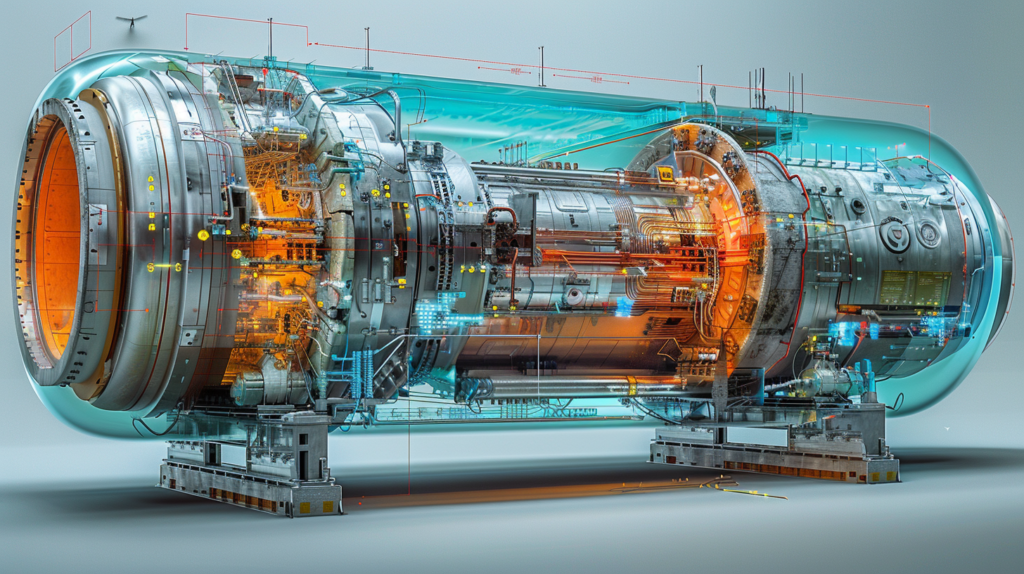
ⓒ 2026 Rich & Rich A detailed photorealistic cross-section of a futuristic Small Modular Reactor (SMR) revealing its complex internal engineering.
In the spring of 2026, the global economy is confronting a brutal reality. The illusions that dominated the market for decades—cheap energy, frictionless trade, and globalized labor division—have evaporated alongside the echoes of conflict in the Strait of Hormuz. For industrial leaders and investors, the primary question is no longer about maximizing the next quarter’s yield. Instead, it is a matter of survival: Is the energy underpinning the supply chain securely under our control?
This shift marks the definitive arrival of Security Capitalism. While the previous era prioritized cost reduction above all else, the current paradigm values resilience against external shocks and the reacquisition of sovereignty at both the state and corporate levels. At the apex of this new order stands the Small Modular Reactor, or SMR. As nuclear energy sheds its monolithic past to be reborn as a precise, modular technology, it has transitioned from a mere utility into the ultimate defensive mechanism for the industrial fortress. This analysis explores how nuclear power became a manufacturing sector, why Big Tech has become its most essential partner, and what this means for the future of the global economy.
Chapter 1: From Construction to Manufacturing, A Paradigm Shift in Energy
Traditional nuclear power plants were among the most massive undertakings in human history. They were titanic civil engineering projects requiring billions of dollars, thousands of workers, and over a decade of labor. However, this sheer scale eventually became a fatal weakness. Prolonged construction timelines led to ballooning capital costs, and even minor regulatory shifts could derail an entire project. Private capital did not avoid nuclear power because of a lack of faith in the physics; it avoided the industry because of uncontrollable financial risk.
SMRs address this issue by moving the needle from construction to manufacturing. The core philosophy of the SMR is modularity. Key components are prefabricated in a controlled factory environment according to standardized processes. Much like assembling a complex machine from precision parts, these factory-built modules are transported via rail or truck to the site for final assembly. This represents the migration of nuclear energy from the unpredictable world of heavy construction to the streamlined world of high-tech manufacturing.
This transition enables the maximization of capital efficiency. By producing reactors repeatedly in a factory setting, companies can leverage the learning curve. While every large-scale plant was essentially a first-of-its-kind prototype with its own set of unique problems, the hundredth SMR module will be significantly cheaper and more refined than the first. For investors, this translates into a predictable revenue model and a much shorter path to break-even, finally opening the door for massive private investment in the nuclear sector.
Chapter 2: Passive Safety, Security Governed by Physical Laws
Public apprehension regarding traditional nuclear power is often rooted in scenarios where human error or mechanical failure leads to a cooling system breakdown. The logic follows that if the power fails, the pumps stop, the reactor overheats, and disaster ensues. SMRs have largely solved this issue by delegating safety not to human intervention, but to the laws of physics.
The safety design of an SMR is based on the principle of passive safety systems. These reactors do not require complex pumps or external power to remain cool; instead, they utilize gravity and natural convection. The fundamental physical truth that hot water rises and cold water sinks serves as the primary safety mechanism. Even if the grid fails and every operator leaves the site, the reactor will naturally cool itself and maintain a stable state.
This technological evolution has completely dismantled the geographical constraints of nuclear power. Because they do not require massive amounts of cooling water from oceans or large rivers, SMRs can be installed deep inland or within industrial complexes near urban centers. This allows for a true realization of energy independence, where energy is produced exactly where it is consumed. In this new era, the most secure energy source can be located directly adjacent to a data center or a mission-critical manufacturing hub.
Chapter 3: The AI Empire and the Inevitable Synergy with Nuclear Energy
The phenomenon of Silicon Valley giants signing power purchase agreements with nuclear firms is a significant indicator of the future. Artificial intelligence is arguably the most power-hungry technology in human history. The data centers required to train and operate large language models now consume energy on the scale of medium-sized cities.
The dilemma for Big Tech is clear. They must honor their commitments to carbon neutrality while requiring a massive, uninterrupted flow of electricity 24 hours a day, 365 days a year. Solar power halts at night, and wind power is at the mercy of the weather. While batteries are improving, they remain insufficient in scale and too costly to bridge the gap. Nuclear energy is the only viable alternative.
SMRs are essentially bespoke energy solutions for the data center industry. By placing an SMR on-site, a data center can insulate itself entirely from the instabilities of the national power grid. In the event of war or a massive cyberattack on public infrastructure, a data center powered by its own SMR will remain operational. If data is the new oil, then the SMR is the engine that keeps the refinery running. In the coming years, the line between Big Tech and energy companies will become increasingly blurred.
Chapter 4: Security Capitalism and the Lessons of Hormuz
The geopolitical crises of 2026 have proven that energy sovereignty is synonymous with the right to survive. When the Strait of Hormuz was threatened and resource shipments were choked, the industries of nations without energy self-sufficiency collapsed almost instantly. The price for chasing efficiency through a reliance on cheap, distant fossil fuels has proven to be devastatingly high.
The SMR is the key to severing these geopolitical chains. Nuclear fuel possesses an extraordinary energy density; a single fueling can provide power for several years. This means the energy supply chain is fundamentally decoupled from immediate external shocks. Even if regional conflicts erupt or resource-rich nations halt exports, an industrial zone equipped with SMRs can maintain its own economic ecosystem in isolation.
Furthermore, SMR technology is becoming a powerful new tool for diplomacy. Nations that export SMR technology do more than just sell electricity; they share a core infrastructure and security framework with the recipient nation. The fierce competition among advanced economies to lead the SMR export market is not merely about economic gain. It is about attaining the status of a digital landlord, co-managing the energy infrastructure of partner nations for decades to come.
Chapter 5: Following the Capital, Where to Watch
Capital is already moving with strategic precision. Investing simply in companies that build reactors is a surface-level approach. A deeper analysis requires looking at the entire supply chain of the SMR ecosystem.
The first area of focus is fuel sovereignty. SMRs often require higher concentrations of fuel than traditional plants. The companies that dominate the market for high-assay low-enriched uranium will control the upstream of future energy. Special attention should be paid to the specialized technologies required to secure and enrich these materials.
The second area is the monopoly on core components. The ability to integrate complex piping into a single vessel and the forging technologies required to create specialized alloys are rare. As the SMR market expands, the dependence on a handful of firms with these capabilities will become absolute, granting them immense pricing power.
The third area is the shift toward service-based operations and maintenance. As thousands of SMRs are deployed globally, a software platform for real-time monitoring and management will become essential. Service models that use AI to prevent accidents and optimize uptime will generate far more value over time than the initial hardware sale. This represents a long-term, stable cash-flow asset in an era of volatility.
Chapter 6: A Pragmatic Path to Net Zero
ESG management and carbon neutrality are no longer optional for corporations; they are essential for survival. However, the intermittent nature of renewable energy remains an unsolved challenge. To maintain industrial competitiveness while reducing emissions, a stable base-load power source is mandatory.
SMRs offer the most realistic alternative to fossil fuel power plants. By utilizing the existing sites and transmission infrastructure of decommissioned coal plants, SMRs can be deployed with significantly reduced time and cost. Additionally, the high-temperature heat generated during operation can be used for hydrogen production or district heating, creating a circular economy of energy. This is the only path that allows for continued economic growth without sacrificing the environment.
Conclusion: A Survival Strategy for the New Industrial Era
The world is returning to an era where hard, physical value dictates the terms of engagement. The brilliant advancements of the digital realm are only as strong as the stable energy and security that anchor them to the ground. An SMR is more than a machine for generating electricity. It is a wall protecting industrial assets, an engine driving future technology, and an insurance policy against geopolitical risk.
We must look past the hidden dangers of cheap, distant resources and instead secure energy sources that we can control, regardless of the cost. This is the only way to thrive in the age of Security Capitalism. Energy sovereignty is an unyielding right, and the SMR is the most viable means of realizing that right. Only those who understand and prepare for this massive shift will lead the new order.